
You turn over a picture card, and your child immediately remembers where its partner is. A moment later, they forget whose turn comes next. Memory games for kids can involve several demands at once: remembering pictures, following rules, waiting, and finding words.
Start with one simple game, a small amount to remember, and permission to ask for a clue. Matching pairs, copying a movement sequence, or rebuilding a tiny block model can all make remembering part of play. You do not need a paid app or a packed activity schedule.
These eight games are aimed mainly at ages 4–10. The age ranges are starting suggestions, not ability tests. Choose by your child’s interests, communication, and comfort with the rules.

What can memory games for kids actually do?
A game gives children a chance to practise the remembering that game requires. Recognising a picture, recalling its position, and holding instructions in mind are related but different tasks.
Working memory means holding information in mind while using it. For example, a child might remember two pretend café orders while deciding which toy plate goes to each customer.
Be careful with promises about “boosting brainpower.” A 2020 meta-analysis of working-memory training in typically developing children found improvements on similar memory tasks, but essentially no improvement in broader intelligence or academic outcomes when stronger comparison conditions were used. It did not test every family game below.
The sensible goal is enjoyable practice, discovering useful strategies, and sharing time together. Memory games for kids should not become a promise of higher grades—or a way to judge a child’s intelligence.
Choose a memory game that fits today
| Your child enjoys… | Try… | Start with… |
|---|---|---|
| Looking at pictures | Matching pairs | Three pairs |
| Spotting small changes | Missing-object detective | Three familiar objects |
| Moving or making gestures | Copy my sequence | Two comfortable actions |
| Building | Build, hide, rebuild | A two-block model |
| Pretend play | Toy café orders | One customer and one item |
| Making up stories | Three-picture story | Three simple pictures |
| Drawing | Remember my silly creature | Two visible features |
| Directing the adult | Toy delivery route | Two nearby destinations |
Before starting, show one practice turn. Say what counts as remembering: the items, their order, their position, or some combination. Unclear rules can make an easy game feel impossible.
Use large, age-appropriate materials. Avoid loose magnets, button batteries, and small pieces around children who mouth objects or younger siblings. Choose a clear, comfortable play space.
8 memory games for kids, with easier and harder versions
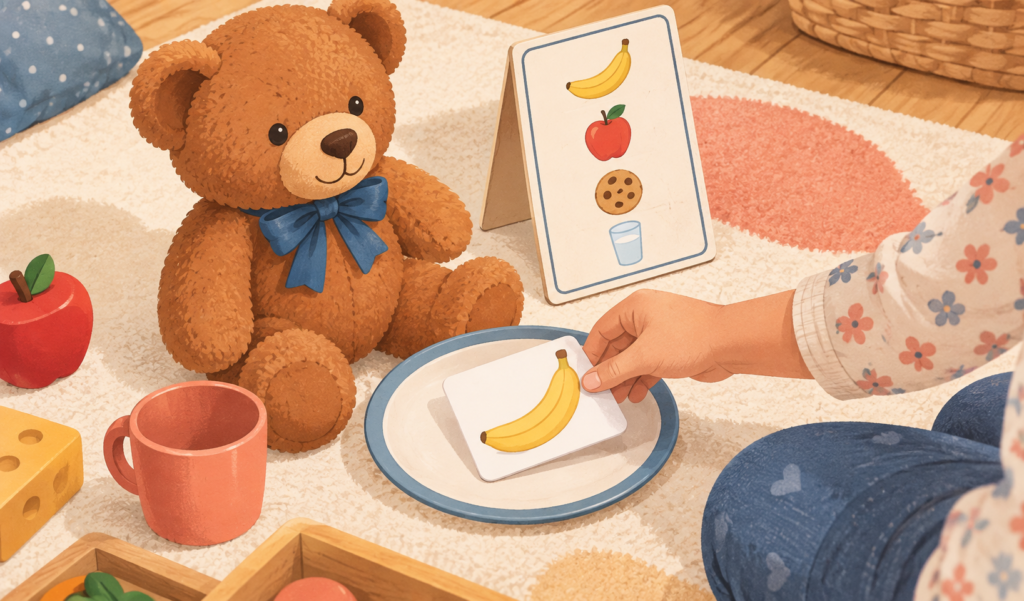
1. Matching pairs: remember where a picture belongs
Suggested ages: 4–8. Materials: six identical-backed cards showing three picture pairs.
Lay the cards face down. Take turns revealing two. Keep a match; otherwise return both to their original places. Work together to collect every pair, taking one turn each whether or not you match.
Practises: remembering picture locations.
Easier: use two pairs or preview the layout. Harder: add one pair. Keep cards in place throughout.
Use large, distinct pictures. A child can point while you turn cards. Naming pictures is optional.
2. Missing-object detective: notice what disappeared
Suggested ages: 4–8. Materials: three familiar, large objects and a cloth.
Explore and name the objects together. Cover them, remove one unseen, then uncover the rest. Ask which disappeared; swap roles afterward.
Practises: recalling a recently seen set.
Easier: use two objects or offer two possible answers. Harder: add an object before removing more than one.
Allow pointing or choosing from pictures. No blindfold is needed.
These two familiar formats also appear in the University of Washington’s Neuroscience for Kids memory activities; the versions here use smaller starting sets and cooperative turns.
3. Copy my sequence: remember a little movement routine
Suggested ages: 4–9. Materials: none.
Agree on comfortable movements, such as touching shoulders, opening hands, or tapping knees. Show two actions, then pause. Your child copies them in order. Next, your child makes a sequence for you.
Practises: recalling an action sequence after watching it.
Easier: show one action or demonstrate again. Harder: add a third action. Avoid increasing speed at the same time.
All movements can be seated. If copying movements is difficult, show two picture cards and let your child arrange duplicates instead. Skip clapping if sudden sounds are unpleasant.
4. Build, hide, rebuild: remember a small model
Suggested ages: 5–10. Materials: two sets of large building blocks and a cloth or cardboard screen.
Make a model with two blocks. Let your child study it, including from the side. Hide it, then invite them to build a copy with their own blocks. Reveal both and compare together: “Which part stayed the same?”
Practises: recalling the position and arrangement of objects.
Easier: leave the model visible for the first attempt, then try hiding it. Harder: add one block or change orientation, not both at once.
Use blocks that differ in shape as well as colour. A child can direct your building through speech, gestures, or their usual communication system. Precise hand movements need not be part of the challenge.
5. Toy café orders: remember what a customer wants
Suggested ages: 5–9. Materials: toy customers, plates, and large pretend food pieces or food pictures.
One toy orders one item: “Bear would like rice.” Your child repeats or indicates the order, chooses the item, and serves it. After a few turns, introduce two customers with different orders. Swap roles so your child can run the café.
Practises: keeping an item and its recipient in mind while acting.
Easier: keep a picture order beside the customer. Harder: take two orders before serving either.
Use familiar foods and your family’s preferred language. A picture menu supports children who prefer pointing. Keep play orders separate from real eating; there is no need to introduce food pressure or unfamiliar tastes.
6. Three-picture story: connect things before recalling them
Suggested ages: 5–10. Materials: three homemade picture cards, such as a dog, an umbrella, and a bus.
Look at the pictures together. Invent a short connection: “The dog carried an umbrella onto the bus.” Turn the cards over. Ask your child to retell the idea or identify the pictures. Then reveal them and enjoy a new story.
Practises: recalling items using a meaningful connection.
Easier: leave one picture visible as a cue. Harder: add a fourth picture.
Accept a different sentence with the same ideas. This is not a word-for-word recitation. Offer drawing, gestures, or picture selection instead of spoken storytelling. Let your child choose familiar subjects rather than testing new vocabulary.
7. Remember my silly creature: recall selected details
Suggested ages: 6–10. Materials: paper and crayons.
Draw a simple imaginary creature with two features, such as round ears and a striped tail. Tell your child those are the details to remember. Study the drawing together, hide it, and invite a new drawing with those features. Compare, then let your child design yours.
Practises: recalling selected visual details.
Easier: describe the features again or leave a small reminder picture. Harder: add one feature or ask where it belongs.
Judge the remembered features, not artistic accuracy. Children who dislike drawing can choose features from picture cards or describe what you should draw. Avoid making the hidden picture elaborate: extra detail changes the task.
8. Toy delivery route: remember where to go next
Suggested ages: 6–10. Materials: a large toy and two nearby, accessible delivery spots.
Create a tiny route within one clear room: “Visit the cushion, then the basket.” Let your child repeat, point out, or trace the route before moving the toy. Finish together and exchange roles.
Practises: holding destinations in sequence while completing an action.
Easier: use a visible route card or one destination. Harder: add a third stop.
Move the toy across a tabletop if walking is unsuitable. Keep eyes open, avoid stairs, and do not turn delivery into a race. The adult can move the toy while the child directs.
Adjust memory games for kids without making them a test

If your child misses several turns, change one demand. Reduce the number of items, allow another look, or remove the requirement to remember their order.
Try: “That was a lot to keep in mind. Shall we use fewer cards or have a clue?”
A clue changes the task; it does not spoil play. Notice which support helps. Remembering an object after seeing two choices is different from naming it without a prompt. Neither response should become a label about the child.
For autistic children, children with ADHD, or any child who benefits from predictability, explain the turn structure and ending in advance. Offer familiar interests, comfortable lighting, and their usual communication tools. Adjust to the individual rather than assuming a diagnosis tells you which game will work.
If disappointment takes over, pause the game. Our guide to helping a child who gets frustrated easily offers further ways to respond calmly.
A five-minute starting routine
Five minutes is a practical suggestion, not a research-backed dose. Stop earlier if your child wants to finish.
- Choose: offer two games and let your child pick.
- Demonstrate: show one easy turn with the answer visible.
- Play: try a few turns at a comfortable level.
- Reflect: ask, “Did looking again, saying it, or making a story help?”
- Finish: let your child choose whether to return another day.
Useful progress might mean asking for a clue, choosing a strategy, or wanting another turn. You do not need a score chart.
If starting screen-free play is the bigger obstacle, see helping children get interested in activities beyond screens. Leave one small game ready, rather than presenting a long list of options.
Help with real tasks as well as games
If the problem is forgetting what to pack for school, practise packing with a visible checklist. Getting better at cards may not solve that problem.
For directions, give one manageable step, check that it was understood, and add a picture or written reminder if useful. Understood’s everyday working-memory strategies include breaking information into smaller parts and making connections between ideas.
Memory games for kids can sit alongside these supports. A child should not have to succeed at a game before receiving reminders during daily routines.
Frequently asked questions
Are online memory games better than homemade ones?
There is no basis here for claiming they are better. Homemade games let you control the number of items, pace, and turn-taking. If you use an app, look for clear rules and adjustable difficulty; treat improvement in its score as improvement on that task.
What if my child remembers pictures but struggles with spoken sequences?
The tasks make different demands. Check that the words are familiar and the instructions clear. Try pictures alongside speech. One game cannot tell you why a child finds something difficult.
Should siblings play at the same difficulty?
They do not need to. One child can use fewer cards or have a preview. Explain the shared goal—finishing together—and let each child choose a manageable challenge.
When should I ask for help with everyday forgetting?
If forgetting repeatedly disrupts learning or daily routines, discuss concrete examples with your child’s teacher and healthcare professional. Explain what happens, where, and which supports help. Game scores alone cannot identify a learning or health condition.
Pick one small game today
Start with three picture pairs or a two-block model. Demonstrate a turn, offer a clue when needed, and stop while play still feels comfortable. The most useful memory games for kids are ones you can adapt to the child in front of you.