
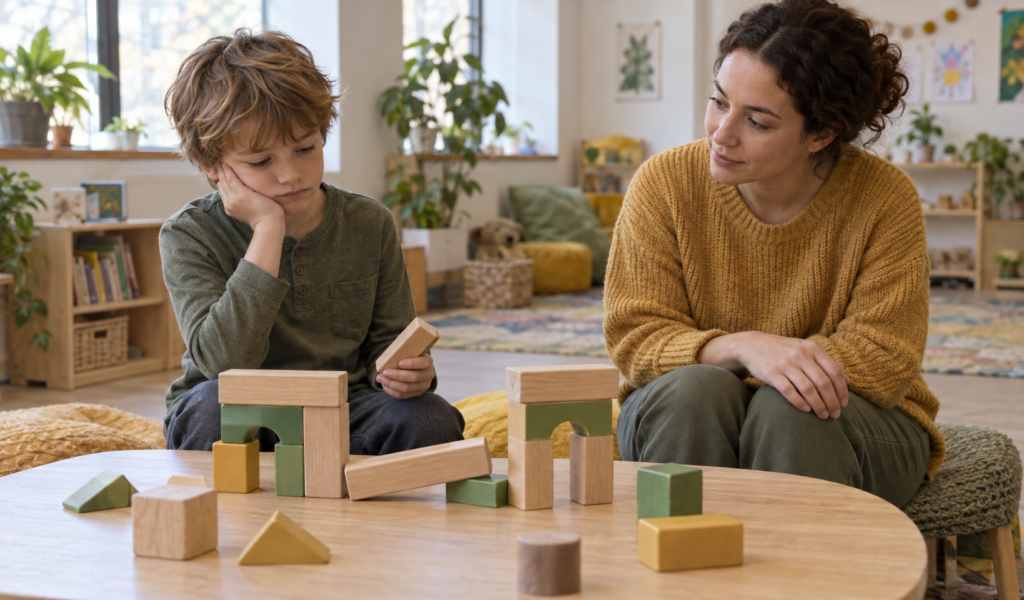
The tower falls. The maths answer is wrong. A drawing does not look the way your child imagined. Suddenly, the activity is pushed away: “I can’t do it.” Helping a child who gives up starts with understanding what made the next step feel impossible.
Pause the pressure, acknowledge the difficulty, and find the smallest useful step you can support. Sometimes that means another attempt. Sometimes it means teaching a missing skill, changing the task, or taking a break.
This guide is for parents and caregivers of children roughly aged 5–12. The aim is to help children learn how to respond to difficulty—not to make them finish everything or hide frustration.
Why a child who gives up may need more than encouragement
“I can’t” does not always mean “I don’t want to try.” It can mean “I don’t understand,” “I’m exhausted,” or “I don’t want anyone to see me get it wrong.” These are possibilities to explore, not diagnoses.
Notice where the pattern appears. Does your child stop during reading but persist with construction toys? Do they struggle more when someone watches? Does the same task go better earlier in the day?
Understood’s guidance on recognising learning challenges recommends looking for patterns rather than drawing conclusions from an isolated difficult moment.
Ask a concrete question: “Which part is stopping you?” If that is too broad, offer choices: “Is it knowing what to do, doing the movement, or worrying it won’t work?” Give time to answer through words, pointing, or your child’s usual communication method.
Help a child who gives up: try, adapt, or pause?
Use this table to choose your response. A child does not have to become completely calm before receiving help, but they need enough comfort and capacity to take part.
| What you notice | A useful response | What it could sound like |
|---|---|---|
| They understand the task and want another attempt | Try one manageable step | “Which piece would you like to test next?” |
| They repeat the same unsuccessful approach | Change the method | “Shall we look at what is making the base wobble?” |
| They cannot explain what the task asks | Teach or clarify | “I’ll show one example. Then we can do one together.” |
| They seem tired, overwhelmed, or increasingly distressed | Pause and meet the immediate need | “We can stop here and decide what to change later.” |
| They fear being watched or compared | Reduce the audience and pressure | “Would you like to practise privately?” |
This is a practical decision aid, not a validated assessment tool. For optional play, stopping is also a valid choice. For necessary schoolwork, involve the teacher when the task remains inaccessible.

1. Connect before giving instructions
Start with what happened, without labelling your child: “You worked on that, and it fell apart. That was frustrating.”
Avoid “You always give up.” It turns one difficult moment into a description of who they are. You can be clear about behaviour without shaming: “I’ll help keep the pieces safe. We can put them down while we pause.”
Research on resilience highlights the importance of supportive adult relationships. Harvard’s Center on the Developing Child describes these relationships as a protective factor during adversity. That research concerns broader adversity; it does not prove that a particular homework phrase changes persistence. It does remind us that support belongs alongside challenge.
If feelings are the immediate obstacle, our guide to helping a child who gets frustrated easily offers related ideas.
2. Make the next attempt smaller and different
A child who gives up may not need the whole task made easy. They may need a starting point they can understand.
Instead of asking for a full paragraph, invite one spoken sentence. Instead of rebuilding a whole tower, examine the bottom two blocks. Instead of practising an entire piece of music again, ask the teacher which short section needs attention.
Make the change explicit: “We are trying a wider base this time.” Another attempt should offer new information, not repeat the same failure with more pressure.
For younger children, show the first step. Older children may prefer choosing between two strategies or explaining their own idea. Age is only a guide; adapt to the child’s actual skills and support needs.
3. Offer help without automatically taking over
Ask what kind of help is welcome: “Would you like a hint, an example, or for us to do one together?”
A possible sequence is:
- Give a small cue: “Look at the shape of that edge.”
- Show a similar example: Demonstrate with another piece or question.
- Work together: Share the next step with permission.
- Step back when useful: Let your child choose what they can try.
You do not have to begin with the least help every time. If your child lacks the skill, a clear demonstration may be kinder and more useful than repeated hints.
Likewise, accommodations are not cheating. An accessible tool, spoken response, quieter workspace, or alternative way to participate may remove a barrier while preserving the learning goal.
4. Replace “try harder” with useful feedback
Encouragement works best as part of actual support. Telling a child who gives up that they “just need confidence” does not explain how to solve the problem.
Use feedback they can connect to something observable:
| Instead of relying on… | Try a specific response |
|---|---|
| “You’re so clever.” | “You checked the instructions when the first idea didn’t work.” |
| “Keep trying!” | “What could we change before another attempt?” |
| “See? That was easy.” | “That took work. Which part helped?” |
| “You can do anything.” | “This skill takes practice and help. Let’s find your next step.” |
These are original examples, not quotations from a study. Keep feedback sincere. If your child tried and the approach still failed, say so kindly: “You gave that method a try. It didn’t solve this part. Let’s ask for a different explanation.”
The message is that effort, information, tools, and support can work together. Effort alone is not a guarantee of success.
5. Make breaks part of the plan
A break can be followed by a return, an adaptation, or a decision to stop. It does not have to mean abandoning every challenge.
Understood’s homework-break guidance describes both movement and quiet options. Choose what suits your child rather than assuming an energetic activity will help everyone.
If returning makes sense, leave a clear starting point: “We’ll leave this piece here. After a rest, we can decide whether to try the wider base.” Avoid turning the break into a countdown to a task that is still too hard.
If your child repeatedly needs to escape the same assignment, ask what must change in the assignment or support. More break timers cannot teach a missing concept.
A worked example: from “I can’t” to one useful attempt
The following is an invented example involving a child building a small bridge with age-appropriate blocks.
Child: “It keeps falling. I’m not doing it.”
Parent: “You wanted the top to stay up, and it fell again.”
Child: “I’m bad at this.”
Parent: “This bridge isn’t working yet. Would you like to stop, or look at one part with me?”
Child: “You do it.”
Parent: “I can show you a wider support on my side. Then you can decide whether to try it on yours.”
If the child agrees, the parent demonstrates rather than rebuilding everything. If they decline, the blocks can stay available for later, where safe.
The useful change is not that the child suddenly loves difficulty. They have a choice, a new strategy, and support. A child who gives up can learn that asking for help is one way to continue.
When persistence means changing the goal
“Never quit” is too simple for real life. Children need help distinguishing a manageable challenge from a poor fit, an inaccessible task, or an unsafe situation.
For an optional club, discuss the reason for leaving at a calm time. Is the child struggling with one skill, missing a friend, or no longer interested? Ask what support or change they would like before deciding together.
If there is bullying, humiliation, pain, or a safety concern, address it directly. Do not ask a child to endure harm to prove resilience.
For homework, explain the situation to the teacher rather than completing it secretly for the child or extending the session indefinitely. For play, allow unfinished projects and changing interests.

Track progress without creating another test
For several ordinary attempts, note three things:
- Where they got stuck: for example, reading the instruction or tolerating a mistake.
- What changed: a demonstration, less noise, a rest, or a smaller step.
- What they did next: asked a question, tried a different method, or communicated that they needed to stop.
These are observations, not points to earn. Do not compare siblings or require a perfect streak of “not giving up.”
A child who gives up might first make progress by explaining the obstacle. Finishing independently may come later—or the task may still need adaptation.
When to seek extra support for a child who gives up
Talk with the teacher if difficulties repeatedly affect one area, such as reading, writing, or understanding instructions. Share concrete examples and ask what happens at school, what has been taught, and which supports have helped.
If the pattern comes with persistent distress, physical complaints, loss of interest, or difficulties with daily life, seek advice from an appropriate healthcare professional. Giving up alone does not identify a learning difference, anxiety, ADHD, or autism.
School-related worry may need its own conversation. Our article on a child who cries before school covers a related concern; it should not replace individual advice about a persistent problem.
Frequently asked questions
Should I make my child finish everything they start?
No. Consider the purpose, demands, and child’s needs. A necessary task may require teaching or adaptation; an optional activity may reasonably end. Discuss commitments calmly rather than deciding during an argument.
Is my child lazy if they ask me to do it?
That request does not tell you the cause. Ask what part they need help with and offer a clear example or shared step. Notice whether the same difficulty appears repeatedly.
What if my child says, “I’m not good at this”?
Respond to the hurt without starting a debate: “You’re really disappointed. Getting this wrong doesn’t define you.” When they are ready, discuss the specific difficulty. Seek support if harsh self-criticism persists.
How quickly should this improve?
There is no reliable timetable for every child. Watch for useful changes across situations and adjust support. Persistent struggles need investigation, not a deadline for becoming more resilient.
Start with one better-supported attempt
The next time you are helping a child who gives up, replace “Just keep trying” with: “What part is hard, and what could help with that part?”
Choose one change together. Offer a smaller step, clearer teaching, a different tool, or a pause. Your child’s next useful lesson may be how to try again—or how to ask for the support that makes trying possible.