

If your child refuses to sleep every night, you are not alone — and you are not failing. This is the story of one mom who tried everything, hit rock bottom on a kitchen floor, and accidentally found the fix that sleep consultants charge hundreds of dollars to tell you. It starts one hour before bedtime. And it works.
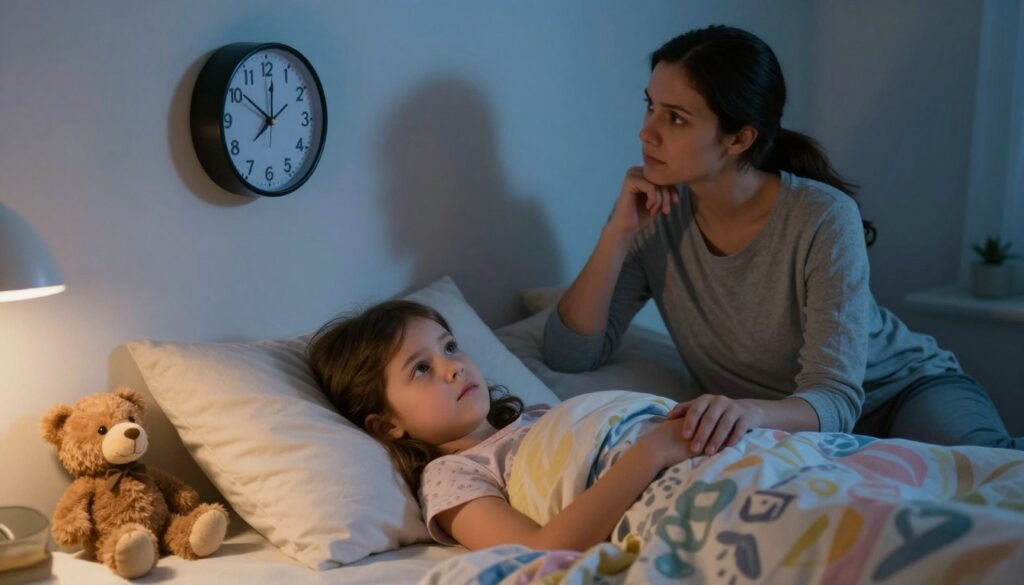
It was 10:47 pm on a Wednesday.
Maya was still awake.
She had been awake since 7:30, when her mom first said the words: “Time for bed.”

Why Your Child Refuses to Go to Bed Every Night
Sarah knew the routine. Or what she called a routine.
Dinner. Some TV. Bath if she remembered. Then the war.
Every single night, the same battlefield. Maya was six. Small enough to carry. Loud enough to rattle the windows.
“I’m not tired.”
“I need water.”
“There’s a noise.”
“My stomach hurts.”
“I forgot to tell you something.”
Sarah had tried everything. Sticker charts with gold stars. Consequences. Gentle warnings. Firm warnings. The kind of warning that made her own voice sound unfamiliar.
She’d tried lying next to Maya until she fell asleep. That worked—until Sarah woke up at midnight, still in the kid’s bed, neck at a terrible angle.
She’d tried the hall light on. Off. Nightlight is in. Nightlight out.
Nothing stuck.
The Bedtime Story Every Exhausted Parent Tells Themselves
Sarah had a theory about Maya. She’d carried it for two years.
Maya is just a difficult sleeper. Some kids are. She got it from her father’s side.
Her friend Jen’s kids were asleep by 7:30. Every night. Jen seemed smug about it — though she’d never actually said anything smug. Sarah had decided she was smug anyway.
Jen probably has easier kids, Sarah thought. Or more patience. Or some gene I didn’t get.
This story mattered. Because as long as Maya’s sleep problem lived inside Maya — inside her personality, her wiring, her father’s side — Sarah didn’t have to change anything.
She was already doing her best. She was already exhausted. What more could anyone ask for?
What Happens When Your Child’s Bedtime Routine Is Actually Working Against You
It was 10:47 pm. Maya was still calling from her room.
Sarah sat on the kitchen floor. Not a dramatic collapse. Just… the floor was there, and her legs stopped working.
She held her wine glass with both hands and stared at the oven clock.
Her husband Dave, was traveling. He’d been traveling a lot lately. She didn’t blame him, exactly. But she noticed he was never home for bedtime.
She thought about the morning coming. The 6:15 alarm. Maya is groggy and impossible to dress. The argument about the shirt with the scratchy collar. The school drop-off where Maya clung to her leg like Sarah was leaving for Antarctica.
Then work. Pickup. Dinner. Then this again.
She felt the loop close around her like a fist.
The One-Hour Bedtime Wind-Down That Actually Stops the Fighting
Her sister Trish had visited two weekends earlier.
Trish had three boys. Ages four, seven, and nine. They went to bed at 8pm. Not because they wanted to. Because the house just… made them.
Sarah had watched it happen and felt quietly furious.
After the kids were down, Trish had poured them both tea and said something Sarah had filed away under easy for you to say.
“The hour before bed is the whole thing,” Trish had said. “I don’t fight them at bedtime. I fight for the hour before.”
Sarah had nodded and changed the subject.
But sitting on the kitchen floor at 10:47 pm, that sentence came back.
I don’t fight them at bedtime. I fight for the hour before.
According to the American Academy of Pediatrics, children aged 6 to 12 need 9 to 12 hours of sleep per night — and consistent bedtime routines are one of the most evidence-backed tools for making that happen. Dr. Judith Owens, a leading pediatric sleep researcher at Boston Children’s Hospital, has said that the wind-down hour before bed is as important as the sleep itself. The brain needs a signal. A command isn’t one.
How Screen Time Before Bed Keeps Kids Awake Longer Than You Think
Sarah thought about the last two hours.
6:45 pm: Maya was watching YouTube on the iPad while Sarah made dinner.
7:15 pm: Dinner. Maya was upset because the pasta touched the sauce incorrectly.
7:40 pm: More iPad while Sarah cleaned up.
8:15 pm: Sarah suddenly remembered it was a school night. “Maya, bed!”
8:16 pm: The war began.
She played it back like footage from a crime scene.
The lights had been bright the whole time. The iPad had been running until ten minutes before “sleep.” Maya had eaten late. There’d been no warning, no transition, no signal to her body that the day was ending.
Research from the National Sleep Foundation shows that screen use within an hour of bedtime delays sleep onset in children by an average of 30 to 60 minutes. The blue light suppresses melatonin. The content keeps the brain alert. It is not a willpower problem. It is a biology problem.
Sarah thought about her own nights when she couldn’t sleep. The ones where she’d been on her phone until midnight and then wondered why her brain wouldn’t stop.
She thought about how Dave always made fun of her wind-down routine. Her chamomile tea. and book with the small lamp. Her rule about no phone after 10.
“That’s different,” she always told him.
Was it, though?

How to Build a Kids’ Bedtime Routine That Works in 4 Simple Steps
The kitchen floor moment didn’t fix everything overnight.
But it cracked the story open.
Maybe it’s not Maya. That thought arrived quietly. Maybe it’s the conditions.
Sarah started small. She moved dinner thirty minutes earlier. She charged the iPad in the kitchen after 7pm. Not as punishment — she told Maya it needed to “sleep too.” Maya accepted this with surprising ease.
She bought a cheap warm-bulb lamp for Maya’s room. She started dimming the main lights at 7:30. The house started to feel different at night. Softer.
She built a four-step bedtime routine. Bath. Pajamas. Two books. One question.
How to stop bedtime battles with your child:
- Cut screens 60 minutes before bed—charge devices in another room
- Dim lights throughout the house at the same time every night
- Follow four steps in the same order: bath, pajamas, books, feelings check-in
- Ask one question: “What was the best part of today?” What was the hardest part?”
- Keep the same bedtime within 30 minutes—even on weekends
The question was always the same: “What was the best part of today? What was the hardest part?”
The first night, Maya said the best part was lunch and the hardest part was “when Jake took my marker.”
Sarah filed that away. Asked Maya’s teacher about it the next day. Small thing. But Maya noticed she’d asked.
The Night the Bedtime Battle Finally Ended
Three weeks in, on a Tuesday that felt like any other Tuesday, something happened.
Sarah finished the second book. She asked the question. Maya thought for a moment.
The best part was swimming. The hard part was nothing. Today was a good day.”
Sarah turned off the lamp. She kissed Maya’s head. and said goodnight.
She walked to the door.
“Goodnight, Mom.”
That was it. No water, and no noise in the closet. No stomachache.
Sarah stood in the hallway and looked at her phone. 8:22 pm.
She went downstairs. The kitchen was clean. The house was quiet. She made tea, sat on the couch, and read for forty minutes.
Why Kids Sleep Better When They Feel Safe and Heard at Bedtime
Maya started waking up more easily. The scratchy-collar arguments got shorter.
Maya started talking more at school pickup and telling stories. The kind of talking that only comes from a kid who has slept.
Sarah stopped dreading 8 pm. She started looking forward to the question. Some nights Maya said things that surprised her. Worried her matters.
One night, Maya said the hardest part was that a girl at school had said Maya wasn’t her best friend anymore.
They talked about it for ten minutes in the dark.
Sarah thought: I would have missed that. If bedtime were still a war, Maya would never have said it. You don’t share your real feelings in the middle of a battle.
The safety of the routine had made the truth possible.
What Your Child’s Bedtime Resistance Is Actually Telling You
Dave came back from his trip on a Thursday.
He watched the routine happen. Stood in the doorway while Sarah read the books. Listened to the question. Watched Maya close her eyes.
Downstairs, he said, “How did you do that?”
Sarah thought about how to answer.
She almost said I figured out Maya.” But that wasn’t right.
She almost said I read something online.” But that wasn’t it either.
What she said was, “I stopped fighting her. I just fixed it an hour before.”
Dave nodded. The way people nod when something sounds simple, but they know it wasn’t.
Maya was never a difficult sleeper.
She was a child living in a bright, loud, screen-filled house until five minutes before her mother expected her to be unconscious. She was a kid who didn’t know what was coming next, who needed a bridge from the busy day to the quiet night. Who needed someone to build that bridge? Because she was six, and six-year-olds can’t build it themselves.
When your child refuses to go to bed, it is not a personality problem. It is a condition problem. And you control the conditions.
Fix the hour before bed. Dim the lights. Kill the screens. Do four steps in the same order every single night. Ask the question. Walk in calmly.
That’s it. Start tonight.





One Comment
Pingback: