
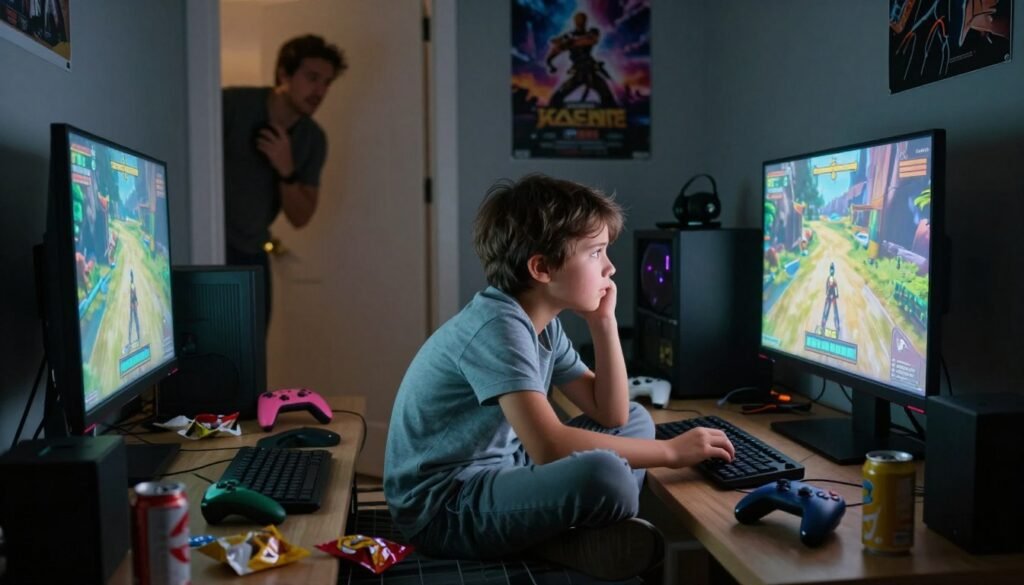
Your kid just threw a controller across the room. Again. You took away the Xbox for one hour. Now they’re crying because someone died. You’re wondering if these are signs your kid is addicted to gaming—or just normal kid stuff.
Here’s what’s strange. These warning signs have been confirmed by people who agree on almost nothing else. A free-market economist. A military psychologist. A progressive sociologist. A Buddhist contemplative teacher. A Wall Street behavioral scientist.
These people fight publicly about taxes, politics, and human nature. But on this? They landed in the exact same place. That convergence should stop you cold.
What Are the Signs of Video Game Addiction in Children?
The single question this content answers most completely:
What are the signs of video game addiction in children? The top warning signs—confirmed independently by experts across every field—include loss of interest in all other activities, explosive anger when interrupted, declining grades, sleep disruption, social withdrawal, lying to protect gaming access, skipping meals, inability to stop voluntarily, preferring the game world to real life, and playing without any visible enjoyment.
Why Most Parents Dismiss This Too Early
Let’s be honest about who resists this conversation.
Maybe it’s you. Maybe you’re a parent who grew up gaming. You think moral panic around screens is overblown, and you distrust helicopter parenting.
You roll your eyes at progressive health scares and conservative media fear-mongering equally and trust data and incentives. And you distrust anyone selling you worry.
That’s a smart position. And it makes what follows even harder to dismiss.
Because the people below aren’t selling worry. They’re selling completely different things—and still ended up here.
What a Libertarian Economist Says About Gaming Compulsion
Edward Castronova is an economist at Indiana University. He studies virtual economies. loves games. and wrote a book celebrating them.
He is not your typical anti-screen crusader.
But Castronova noticed something he couldn’t ignore. Game designers engineer compulsion loops deliberately. Variable reward schedules. Artificial scarcity. Social pressure mechanics. These are the same tools casinos use.
His conclusion was blunt. When a child chooses a virtual world over every real-world reward, that’s not preference. That’s a broken incentive system.
Watch for these economic red flags he identifies:
- The child stops valuing real rewards. Money, praise, and trips no longer motivate them.
- Real-world costs become invisible. Hunger, sleep, and friendships—all get ignored.
- The game becomes the only currency that matters.
A libertarian follows incentives everywhere. Even into your living room.
How Military Psychologists Identify Video Game Addiction Warning Signs
Lt. Col. Dave Grossman spent decades training soldiers. His entire career is built on one question: what makes people sharp under pressure — and what destroys that sharpness?
Performance, resilience, and mental readiness are his metrics. Progressive health frameworks don’t interest him. What interests him is whether a person can function when it counts.
Grossman watched a generation of recruits arrive already broken. Boredom was unbearable to them. Sitting still for 60 seconds was a struggle. Waiting for anything felt impossible.
His warning signs read like battlefield readiness tests:
- Inability to focus without constant stimulation. The child can’t read, sit still, or wait.
- Rage response to interruption. They react to “Dinner’s ready” like a threat to survival.
- Loss of goal-setting ability. They can’t work toward anything for days or weeks.
A soldier evaluates capacity. And he sees children whose capacity is eroding.
What Progressive Sociologists Find in High-Risk Households
Dr. Dmitri Williams at USC studies how games affect communities. He’s not concerned with individual behavior. He tracks systemic outcomes across race, class, and access.
He’d disagree with Grossman on almost every policy question you can name.
But Williams documented something uncomfortable. According to his research, addiction-level gaming hits hardest in high-stress, low-income households where parents are least available. The game becomes an escape hatch. Then a trap.
His social warning signs point to the same problem:
- The child uses gaming to avoid family conflict. Every argument sends them back to the screen.
- Gaming replaces real-world social skills. They struggle with eye contact, group conversation, and conflict resolution.
- They say the game world feels more fair or more real than actual life.
That last one should stop you. A ten-year-old who prefers a fictional world isn’t just gaming. They’re retreating.
What Buddhist Teachers Recognize as Compulsive Gaming Behavior
Tenzin Priyadarshi is a Buddhist scholar and ethicist at MIT. He works with tech companies on conceptual approaches to design. and he thinks carefully about attention, craving, and suffering.
He would disagree with the economist on the primacy of incentives. He’d disagree with the soldier on the value of discomfort training.
But Tenzin uses a specific word for what he sees in addicted children: tanha. It means craving that can never be satisfied.
His warning signs:
- The child is never content. They finish one game and immediately need the next hit.
- They can’t be present. They can’t enjoy a meal, a conversation, or a sunset without reaching for a device.
- They suffer when not playing — but show no joy when they are.
That last sign is the most important one. Addiction doesn’t feel good. It just feels necessary.
How Behavioral Scientists Diagnose Problematic Gaming in Kids
People who build financial risk models don’t deal in feelings. They deal in probabilities, variables, and measurable outcomes.
Behavioral economists who study consumer psychology track one thing: when does a behavior become self-destructive despite clear negative feedback?
Normal behavior changes when it produces pain. Addictive behavior in children does not.
Their clinical red flags are precise:
- The behavior continues despite obvious consequences. Grades drop. The child keeps gaming.
- Promises get made and broken on repeat. “Just one more hour” becomes a daily ritual.
- The child lies to protect access. Hidden devices. Fake sleep. Secret accounts.
Lying is the clearest signal. A child who deceives you to protect gaming access has already decided the game is worth more than your trust. That’s not a phase. That’s a priority structure.
The 10 Video Game Addiction Signs in Children All Experts Agree On
Here’s the remarkable part. Strip away the ideology. Remove the frameworks.
Five people who would argue furiously about everything else gave us overlapping lists. The World Health Organization added Gaming Disorder to the ICD-11 in 2019—validating what these experts had been documenting separately for years.
The agreed-upon signs of video game addiction in children:
- Loss of interest in everything else. Sports, friends, hobbies — all fade. Only the game matters.
- Explosive anger when interrupted. Not disappointment. Rage that’s completely out of proportion.
- Declining school performance. Not a bad week. A sustained drop over months.
- Sleep disruption. Staying up late to play. Waking up to play. Exhausted every day.
- Social withdrawal. Preferring online relationships. Avoiding family events.
- Lying and secrecy. Hiding devices, minimizing time spent, creating fake stories.
- Physical neglect. Skipping meals. Ignoring hygiene. Ignoring headaches and eye pain.
- Inability to stop voluntarily. “I’ll stop at 9 pm” never happens without a fight.
- The game feels more real than real life. This is the deepest warning sign.
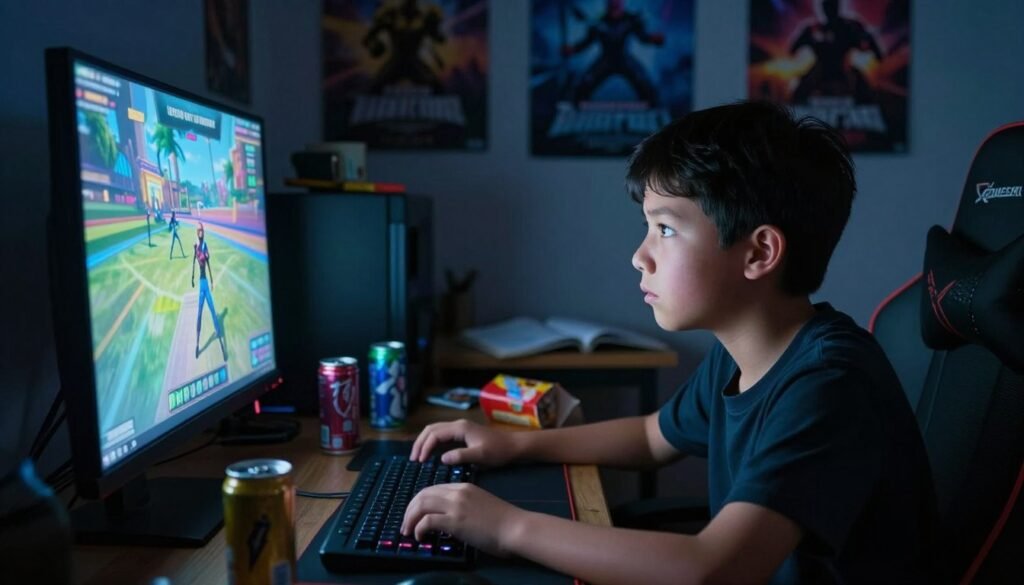
- No joy — just compulsion. They don’t look happy playing. They look trapped.
Why Ideological Convergence on This Issue Should End the Debate
You could dismiss one expert. You could say the economist is cold, the soldier is tough, the monk is mystical, the sociologist is political, and the quant is clinical.
But dismissing all five at once requires a level of motivated reasoning most people can’t sustain.
When people who fight about everything else land in the same place, that’s not ideology. That’s reality pressing through.
The signs of video game addiction in children don’t care about your politics. They show up in libertarian homes and progressive ones. In wealthy neighborhoods and struggling ones, and in kids In six-year-olds and sixteen-year-olds.
The pattern doesn’t discriminate.
Why This Isn’t an Argument Against Video Games
This is not a call to ban games. None of the five experts above would support that.
Games can build problem-solving skills. They can create genuine friendships. They can teach persistence and pattern recognition.
The economist celebrates game design. The soldier respects competitive gaming. The sociologist sees community value. The monk plays chess. The quant model’s optimal decision-making in games.
The issue is not gaming. The issue is when gaming takes over everything else. When it stops being a choice and becomes a compulsion.
There’s a clear line. Most kids never cross it. But some do. And the signs are unmistakable once you know what to look for.
What Parents Should Do When They See These Warning Signs
Start with honest observation. Not surveillance. Don’t panic. Just clear eyes.
Watch for three days. Does your child choose gaming over every other available option, every single time? Do they show real distress when they can’t play? Do they lie about it?
Yes, one is a conversation. Three yeses is a real problem.
Talk to your child the way a smart friend would talk to you. Not a lecture. A conversation about what the game gives them that real life isn’t giving them right now.
The game is never really the problem. It’s the solution your child found to a problem you haven’t seen yet.
Every expert on this list—the economist, the soldier, the sociologist, the monk, the quant—would tell you the same thing: the warning signs of video game addiction in children are visible, measurable, and consistent. You don’t need a diagnosis to act. You need to look.
Start looking today. If three or more signs on that list apply to your child right now, don’t wait for a school counselor to bring it up first. Talk to your child’s pediatrician this week—and have that list in your hand when you do.